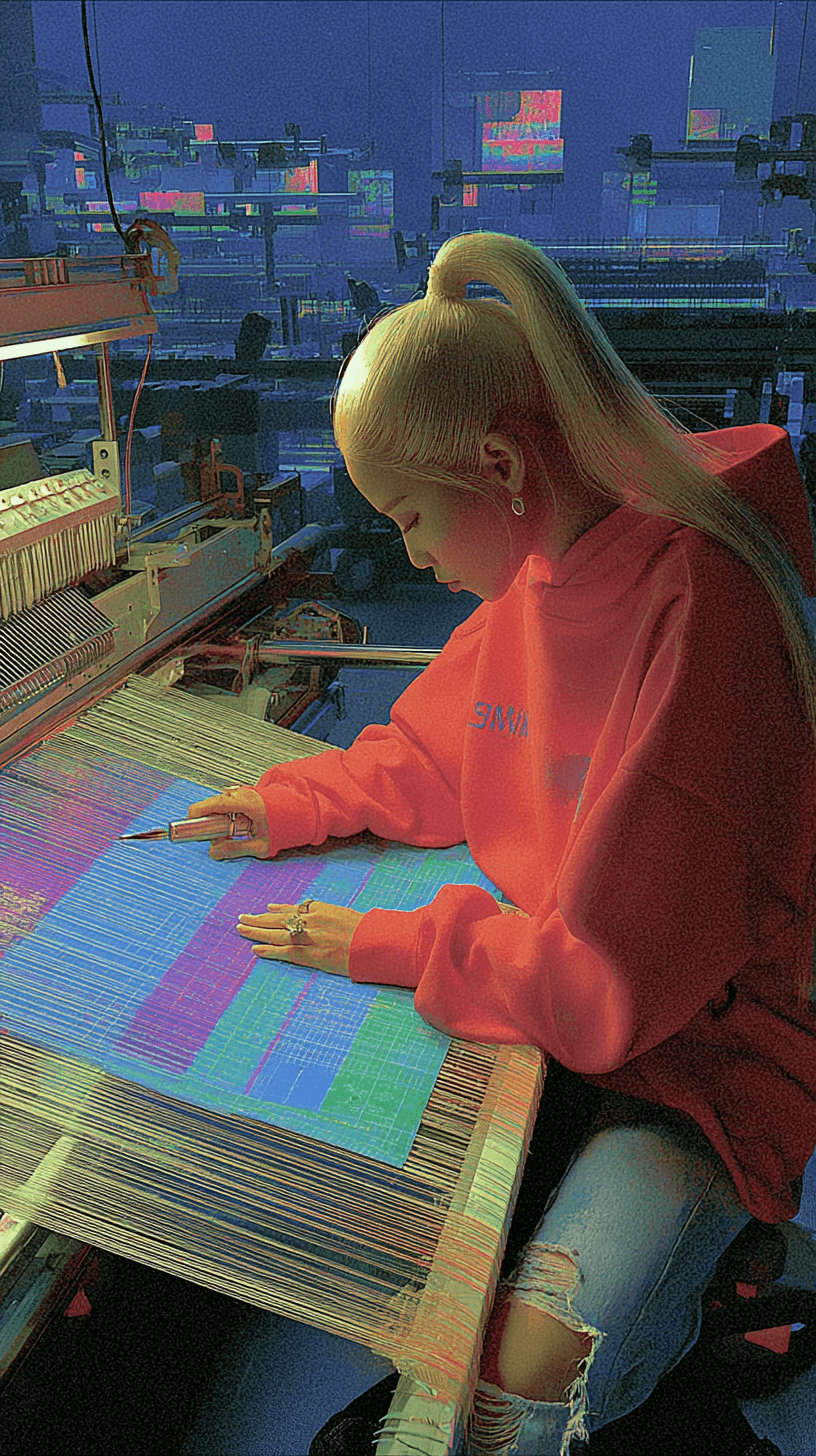
No catalog, no protected library. Just a set of pattern instructions released into the commons. A weave structure, a cut system, maybe parametric rules for sizing or drape. Published as CC0. Not as a “drop,” not as IP. Just placed into the substrate.
That act does one thing: it removes negotiation from the start of the pipeline. Anyone—another designer, a small workshop, a digital fabrication lab—can pick it up and begin. No licensing step, no permission loop. The pattern becomes a starting state, not a finished product.
From there, the pipeline splits immediately into two tracks: open design evolution and localized realization.
On the open side, others fork the pattern. Adjust tension ratios. Change panel geometry. Translate it into knit instead of weave. Feed it into simulation tools. Train small models on variations of it. None of these forks need to reference the original in a legal sense, but they often will in a social or cryptographic sense—signatures, hashes, lineage markers. Not required, but useful.
This creates a living graph of design evolution. No central authority, no canonical version. Just branches that gain or lose attention. On the realization side, a workshop decides to produce a run. Now the problem is no longer “who owns the design,” but “how do we execute it in material.”
They choose:
- fiber (cotton, wool, synthetics, blends)
- source (local, recycled, imported)
- loom type (manual, semi-automatic, CNC)
- finishing process (dye, wash, treatment)
These decisions are not encoded in the CC0 pattern. They are context. This is where differentiation actually happens.
At this point, a digital thread starts forming alongside the physical process.